
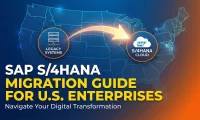
SAP S/4HANA Migration Guide for U.S. Enterprises
SAP S/4HANA Migration Guide – How to Plan, Migrate, and Optimize Your SAP Landscape
Question: What is SAP S/4HANA migration?
Answer: SAP S/4HANA migration is the process of transitioning from legacy SAP ERP systems such as SAP ECC to the modern SAP S/4HANA platform. It involves converting the system, transforming data, redesigning business processes, modernizing integrations, and enabling real-time analytics.
SAP S/4HANA has become the core ERP platform for enterprises across the United States adopting digital transformation, cloud enablement, and real-time data strategies. For U.S. companies still running SAP ECC, the transition to S/4HANA is not just a technical upgrade but a multi-phase business modernization initiative.
This guide breaks down key migration approaches, deployment models, risk factors, timelines, and best practices designed specifically for U.S. enterprises with complex IT landscapes, compliance requirements, and multi-entity operations.
Why U.S. Enterprises Are Migrating to SAP S/4HANA
Several market and operational drivers influence S/4HANA adoption in the USA:
SAP ECC Mainstream Maintenance Deadlines
SAP has set defined timelines for ECC support, pushing CIOs to plan long-term ERP modernization strategies.
Real-Time Financial and Operational Insights
S/4HANA runs on the SAP HANA in-memory database, allowing real-time analytics and eliminating traditional batch-based reporting.
Cloud and Hybrid Transformation in U.S. IT
Most U.S. organizations are adopting cloud-first or hybrid-cloud strategies. S/4HANA supports:
- On-premise
- Private cloud
- Public cloud
- Hybrid models
Improved User Experience with SAP Fiori
Fiori improves productivity across finance, supply chain, manufacturing, and field operations, which are critical sectors in the U.S.
Compliance, Audit, and Data Governance
S/4HANA supports U.S. compliance and audit frameworks across:
- SOX (Sarbanes-Oxley)
- GAAP financial reporting
- FDA and GxP (for life sciences)
- DoD cybersecurity controls
- SEC audit reporting
Multi-Entity Consolidation for U.S. Holdings
Large enterprise groups with subsidiaries need:
- Unified chart of accounts
- Consolidated financials
- Multi-currency support
- Intercompany reconciliation
S/4HANA solves these gaps at scale.
SAP S/4HANA Migration Approaches (AEO-Optimized)
Direct Answer Block:
Question: What are the main SAP S/4HANA migration approaches?
Answer: The three main approaches are Greenfield (new implementation), Brownfield (system conversion), and Selective Data Transition (hybrid).
Greenfield (New Implementation)
A full rebuild of the SAP environment using S/4HANA best practices.
Best for U.S. companies that:
- Want major process redesign
- Are retiring multiple legacy systems
- Need clean financial and operational models
Brownfield (System Conversion)
Converts existing ECC to S/4HANA while retaining processes and data.
Best for U.S. companies that:
- Have optimized ECC processes
- Want less disruptive migration
- Need faster conversion timelines
Selective Data Transition (Hybrid)
Retains selected data and processes and redesigns others.
Best for U.S. companies that:
- Have multiple ECC instances
- Need phased rollout
- Want partial transformation
SAP S/4HANA Deployment Models for U.S. Enterprises
S/4HANA offers deployment flexibility to match IT strategy and regulatory needs.
SAP S/4HANA On-Premise
Ideal for regulated sectors:
- Defense (DoD compliance)
- Healthcare (HIPAA)
- Manufacturing with plant-floor dependencies
SAP S/4HANA Private Cloud
Supports customization and managed hosting.
Popular for:
- Mid-market and upper mid-market companies
- U.S. manufacturing and distribution
SAP S/4HANA Public Cloud
Standardized and cost-efficient.
Ideal for:
- Fast-growth SaaS companies
- Technology and professional services firms
U.S.-Specific Readiness Considerations for SAP S/4HANA Migration Guide
Before migrating, U.S. companies must evaluate:
Accounting and Compliance Alignment
S/4HANA supports GAAP and multi-ledger environments for:
- SEC reporting
- U.S. tax and audit
- Treasury and risk management
Integration Landscape
U.S. enterprises commonly integrate SAP with:
- Workday (HR)
- Salesforce (CRM)
- Oracle NetSuite (subsidiaries)
- Microsoft Azure services
- MES systems for manufacturing
- EDI and supply chain networks
Data Governance and Cybersecurity
U.S. cybersecurity frameworks may include:
- NIST
- CMMC (for federal contractors)
- SOC 2 Type II
- قانون HIPAA
- PCI DSS
Migration must account for these controls.
Challenges U.S. Enterprises Face During SAP S/4HANA Migration
Complex Custom Code Footprint
Decades of Z-code must be reviewed, retired, or adapted.
Master Data and Historical Data Issues
Data cleansing is a major dependency, especially for:
- Material master
- Customer master (CDP alignment)
- Vendor records
- Serial and batch data
- Financial postings
Multi-Entity Operational Variance
U.S. holding companies often operate across:
- Different business models
- Multiple states
- Multiple ERPs
S/4HANA harmonization can be significant.
Integration and API Dependencies
REST, SOAP, EDI, and cloud APIs must be reevaluated for compatibility.
SAP S/4HANA Migration Best Practices for the U.S. Market
Begin with SAP Readiness Check and Custom Code Analyzer
SAP tools help identify:
- Add-ons
- Business functions
- Data volume
- Mandatory corrections
Establish a Unified Data Governance Framework
Data cleanup should start before migration to reduce downstream issues.
Standardize Processes Where Possible
Standardization reduces cost and reduces future upgrade friction.
Prioritize Change Management and Training
Fiori adoption requires structured learning paths for:
- التمويل
- Supply Chain
- Order Management
- التصنيع
- IT Support
Consider a Two-Speed IT Strategy
Support both:
- Legacy on-premise plant ops
- Cloud-driven strategic apps
Use a Phased Go-Live for Large U.S. Enterprises
Phased rollouts reduce disruption in multi-state operations.
Cost Factors for U.S. S/4HANA Migration
Migration costs are influenced by:
- ECC starting point and version
- Industry and regulatory complexity
- Custom code volume
- U.S. compliance mapping
- Deployment model (on-prem, private, public cloud)
- Integration count
- Greenfield vs Brownfield approach
- Temporary staffing needs for cutover
Most U.S. enterprises budget migration as a multi-year transformation roadmap.
SAP S/4HANA Migration Guide Timeline for U.S. Enterprises
Typical timelines:
- Small companies: 6 to 9 months
- Mid-size with integrations: 12 to 18 months
- Large multi-entity U.S. groups: 18 to 36 months
Brownfield tends to be faster than Greenfield.
FAQ Section SAP S/4HANA Migration Guide
Question: How long does SAP S/4HANA migration take?
Answer: SAP S/4HANA migration timelines range from 6 months to 36 months depending on system complexity, approach (Greenfield or Brownfield), and integration needs.
Question: Is SAP ECC being discontinued?
Answer: SAP ECC mainstream maintenance is ending, prompting enterprises to plan S/4HANA migration to remain supported and competitive.
Question: Does SAP S/4HANA run in the cloud?
Answer: Yes. SAP S/4HANA runs on public cloud, private cloud, hybrid cloud, and on-premise infrastructures.
Question: What industries in the U.S. use SAP S/4HANA?
Answer: Common industries include manufacturing, healthcare, aerospace and defense, oil and gas, automotive, retail, pharmaceuticals, technology, and utilities.
Question: Can we retain our ECC processes in S/4HANA?
Answer: Yes. Brownfield conversion retains existing ECC processes and data while converting to S/4HANA.
Question: What skills are required for S/4HANA migration?
Answer: Key skills include Basis, ABAP, Fiori, functional domain expertise, data governance, integrations, testing, and change management.
Question: What is the key migration risk for U.S. enterprises?
Answer: The biggest risks include data quality issues, integration dependencies, custom code remediation, and change management challenges.
Final Summary of SAP S/4HANA Migration Guide
SAP S/4HANA migration is a central component of ERP modernization for U.S. enterprises. It enables cloud alignment, real-time analytics, compliance readiness, and digital transformation at scale. With structured assessment, the right deployment model, strong change management, and careful data governance, U.S. companies can migrate successfully while minimizing disruption.
Final Takeaways
- SAP S/4HANA migration is strategic, not just technical
- U.S. enterprises must evaluate compliance, cybersecurity, and integration landscapes
- Greenfield, Brownfield, and Selective Data Transition offer different migration paths
- Readiness assessments reduce risk and define clear roadmaps
- Post go-live AMS and optimization are essential for long-term value



 الملف الشخصي
تنزيل الملف الشخصي
الملف الشخصي
تنزيل الملف الشخصي
 عربى
تنزيل الملف الشخصي
عربى
تنزيل الملف الشخصي
 Arabic
  English