Managed Cybersecurity Services in Saudi Arabia: Complete Guide for 2025
Introduction
Saudi Arabia’s rapid digital transformation—driven by Vision 2030, cloud adoption, and smart technologies—has opened new opportunities for businesses. However, it has also made companies more vulnerable to cyberattacks. From phishing scams to sophisticated ransomware, Saudi businesses face growing risks that demand robust Managed cybersecurity services.
According to the Saudi National Cybersecurity Authority (NCA), cybercrime costs in the Kingdom are projected to rise significantly in 2025. As a result, investing in professional cybersecurity services is no longer optional—it is a business survival strategy.
In this blog, we’ll explore the importance, benefits, challenges, comparisons, and best practices of cybersecurity services in Saudi Arabia, with a focus on helping businesses—from SMEs to enterprises—protect their digital assets.
Top 10 Cybersecurity Challenges for Businesses in Saudi Arabia in 2025
- Ransomware Attacks – Hackers lock critical files and demand payment, a growing threat for banks, oil & gas, and healthcare firms.
- Phishing and Social Engineering – Cybercriminals trick employees into revealing passwords or sensitive data.
- Cloud Security Risks – With rapid cloud migration, misconfigurations often expose sensitive business data.
- Third-Party Vendor Risks – Weak security in supplier networks can lead to breaches in your systems.
- Regulatory Compliance – Meeting NCA and SAMA regulations is complex and costly without expert support.
- Advanced Persistent Threats (APTs) – Long-term, stealthy attacks targeting critical infrastructure.
- IoT Vulnerabilities – Smart devices in factories, logistics, and healthcare are often poorly protected.
- Insider Threats – Disgruntled employees or careless staff can cause massive data leaks.
- Data Privacy Concerns – With new data protection laws, safeguarding customer data is a must.
- Shortage of Skilled Cybersecurity Professionals – Demand in Saudi Arabia far exceeds supply, leaving many businesses unprotected.
Top 10 Cybersecurity Challenges for Businesses in Saudi Arabia in 2025
| # | Cybersecurity Challenge | Description |
|---|---|---|
| 1 | Ransomware Attacks | Hackers encrypt critical files and demand ransom—particularly dangerous for oil & gas, banking, and healthcare sectors. |
| 2 | Phishing & Social Engineering | Cybercriminals trick employees into revealing credentials or sensitive data. |
| 3 | Cloud Security Risks | Misconfigured cloud setups lead to exposure of business-critical information. |
| 4 | Third-Party Vendor Risks | Weak security in partner ecosystems causes data leakage. |
| 5 | Regulatory Compliance | Meeting NCA and SAMA cybersecurity frameworks is complex without expert support. |
| 6 | Advanced Persistent Threats (APTs) | Long-term, stealth attacks that target national infrastructure. |
| 7 | IoT Vulnerabilities | Smart devices often lack proper security patches. |
| 8 | Insider Threats | Malicious or careless employees cause internal breaches. |
| 9 | Data Privacy Concerns | Strict Saudi Data Protection Law (PDPL) requires new compliance measures. |
| 10 | Cybersecurity Skills Gap | The demand for certified cybersecurity professionals exceeds supply in the Kingdom. |
Cybersecurity Services in Saudi Arabia vs. In-House IT Security: Which Is Better?
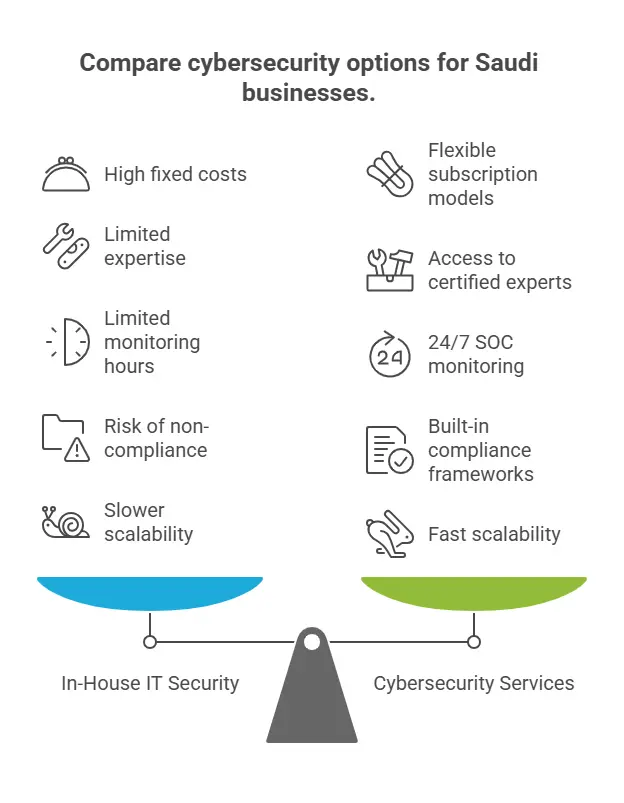
Businesses in Saudi Arabia face increasing cyber threats in 2025, from ransomware to phishing attacks. The decision between building an in-house IT security team or outsourcing to a cybersecurity service provider is critical. Below is a detailed comparison.
🔹 Cost
- In-House IT Security:
- Requires hiring skilled staff, training, tools, and infrastructure.
- High fixed costs that increase as the business grows.
- Cybersecurity Services in Saudi Arabia:
- Flexible subscription or pay-as-you-go models.
- Lower upfront investment, scalable with business needs.
Building an in-house security team in Saudi Arabia demands heavy investments in salaries, training, and advanced tools. For SMEs and mid-sized companies, this can strain budgets. On the other hand, managed cybersecurity services offer cost-effective, scalable solutions, allowing businesses to pay only for what they use.
🔹 Expertise
- In-House IT Security:
- Limited to the knowledge and skills of the team you hire.
- Hard to keep up with evolving cyber threats.
- Cybersecurity Services in Saudi Arabia:
- Access to certified experts (CISSP, CISM, ISO 27001).
- Continuous threat intelligence updates.
Cybersecurity is a constantly evolving field. An in-house team may not always stay updated with the latest threats and compliance requirements. By outsourcing, businesses tap into global expertise and real-time intelligence, ensuring better protection.
🔹 Monitoring & Response
- In-House IT Security:
- Monitoring is limited to office hours unless a 24/7 team is maintained.
- Incident response speed depends on team size and skills.
- Cybersecurity Services in Saudi Arabia:
- 24/7 Security Operations Center (SOC) monitoring.
- Faster detection and response to cyberattacks.
- Cyberattacks don’t follow business hours. While in-house teams may leave gaps, cybersecurity providers in Saudi Arabia deliver round-the-clock monitoring through advanced SOCs, reducing downtime and damage.
🔹 Compliance
- In-House IT Security:
- Requires deep understanding of NCA, SAMA, and GDPR.
- Risk of non-compliance penalties if not updated.
- Cybersecurity Services in Saudi Arabia:
- Providers specialize in compliance with Saudi and international standards.
- Built-in audits and reporting.
Compliance is a major challenge for Saudi businesses, especially in regulated sectors like banking and healthcare. Outsourced cybersecurity services simplify compliance by offering pre-built frameworks aligned with NCA and SAMA regulations, saving time and reducing risks.
🔹 Scalability
- In-House IT Security:
- Scaling requires hiring more staff and buying new tools.
- Slower to adapt to rapid growth.
- Cybersecurity Services in Saudi Arabia:
- Easily scalable as your business expands.
- Add or remove services without heavy investments.
Saudi businesses under Vision 2030 are scaling rapidly, moving to cloud and digital-first models. Outsourced cybersecurity services allow fast scalability, unlike in-house teams that require long hiring and training cycles.
Final Verdict
- In-House IT Security works best for large enterprises with big budgets and highly regulated environments that require complete control.
- Cybersecurity Services in Saudi Arabia are the better choice for SMEs and mid-sized companies, offering cost savings, compliance support, and 24/7 protection.
While in-house IT security offers more control, most Saudi businesses—especially SMEs and growing enterprises—benefit more from managed cybersecurity services. They provide affordable, expert-led, and scalable protection, ensuring business continuity in a high-risk digital landscape.
| Factor | In-House IT Security | Cybersecurity Services in Saudi Arabia (MSSP) |
|---|---|---|
| Cost | High (salaries, training, tools) | Scalable and subscription-based |
| Expertise | Limited to team skills | Access to global-certified experts |
| 24/7 Monitoring | Difficult and costly to maintain | Round-the-clock Security Operations Center (SOC) |
| Compliance | Needs internal effort | Guided by compliance specialists (NCA, SAMA, GDPR) |
| Scalability | Limited | Easily scalable as business grows |
👉 Verdict: Most businesses in Saudi Arabia—especially SMEs—find outsourced cybersecurity services more cost-effective, reliable, and compliant.
AI-Powered Cyber Defense: The Future of Managed Security
By 2025, AI-driven cybersecurity will be central to defending against zero-day threats and ransomware. TFORCE integrates Generative AI and machine learning into its cybersecurity stack for predictive defense.
AI in Managed Cybersecurity Includes:
- Automated Threat Detection: AI identifies anomalies faster than human analysts.
- Behavioral Analytics: Tracks user behavior to detect insider threats.
- Generative AI Insights: Creates dynamic security reports and incident summaries.
- Predictive Intelligence: Anticipates future attack vectors based on data patterns.
TFORCE’s AI-enabled SOC allows Saudi businesses to respond proactively, not reactively.
Regulatory Compliance in Saudi Arabia: NCA, SAMA & PDPL
Saudi Arabia has implemented some of the world’s most robust cybersecurity frameworks:
| Regulatory Authority | Focus Area | Requirement for Businesses |
|---|---|---|
| NCA (National Cybersecurity Authority) | National security & data protection | Compliance with Essential Cybersecurity Controls (ECC) |
| SAMA (Saudi Arabian Monetary Authority) | Banking & financial institutions | SAMA Cybersecurity Framework adherence |
| PDPL (Personal Data Protection Law) | Data privacy | Consent-based data collection & retention rules |
TFORCE helps clients audit, align, and comply with these frameworks, reducing legal risks and penalties.
How Managed Cybersecurity Services Protect SMEs in Saudi Arabia from Cyber Threats
Small and medium-sized enterprises (SMEs) are often targeted because attackers assume they have weaker defenses. Cybersecurity services provide SMEs with:
- Firewall and Intrusion Detection Systems (IDS) to block malicious traffic.
- Endpoint Protection to secure employee laptops and mobile devices.
- Cloud Security for Microsoft 365, Google Workspace, and other SaaS tools.
- Email Security to prevent phishing and business email compromise.
- Security Awareness Training to empower employees against attacks.
By outsourcing to a Managed Security Service Provider (MSSP), SMEs can enjoy enterprise-grade protection without the cost of building a full internal security team.
Why Managed Cybersecurity Services Are Crucial for Saudi Arabian Companies
Cybersecurity in Saudi Arabia is not just about technology—it is about business continuity, compliance, and reputation.
- Compliance with NCA and SAMA – Avoid heavy penalties and legal risks.
- Protection of Critical Infrastructure – Especially in oil & gas, banking, and healthcare.
- Customer Trust – A single breach can ruin a company’s credibility.
- Cost Savings – Preventing an attack is far cheaper than paying ransom or recovering from downtime.
- Vision 2030 Goals – The Kingdom’s digital economy can only succeed with strong cybersecurity foundations.
How to Choose the Right Managed Cybersecurity Service Provider in Saudi Arabia
When selecting a provider, businesses should look for:
- Local Experience – Familiarity with Saudi business culture and regulations.
- Compliance Expertise – Knowledge of NCA and SAMA frameworks.
- 24/7 SOC Monitoring – To ensure real-time protection.
- Scalable Solutions – From SMEs to large enterprises.
- Proven Track Record – Client case studies and industry certifications (ISO 27001, CISSP).
When selecting a cybersecurity provider, focus on:
- Local Expertise: Understanding Saudi data laws and Vision 2030 goals.
- 24/7 SOC & Threat Monitoring
- Proven Compliance Experience (NCA, SAMA)
- Scalable & Transparent Pricing Models
- ISO 27001, CISSP, CISM-certified Professionals
Checklist for Selecting the Best Managed Cybersecurity Partner in Saudi Arabia
When choosing a cybersecurity partner in Saudi Arabia, businesses must ensure they are not only addressing current risks but also preparing for future threats. Here’s a quick checklist to guide your decision:
- ✅ Industry Expertise – Does the partner understand your sector-specific risks (e.g., oil & gas, finance, healthcare)?
- ✅ Comprehensive Service Offering – Look for end-to-end solutions including threat detection, incident response, managed SOC, and compliance support.
- ✅ Local Presence & Compliance Knowledge – A partner should align with Saudi Arabia’s cybersecurity regulations and data residency requirements.
- ✅ 24/7 Monitoring & Rapid Response – Continuous protection and quick remediation are essential.
- ✅ Proven Track Record – Client testimonials, case studies, and global-standard certifications highlight trustworthiness.
- ✅ Scalable Solutions – Ensure the partner can adapt services as your business grows.
Why TFORCE is the Best Managed Cybersecurity Partner in Saudi Arabia
TFORCE stands out as the leading cybersecurity partner in Saudi Arabia because it blends global expertise with local compliance knowledge. Unlike generic IT vendors, TFORCE delivers specialized managed cybersecurity services tailored to the Kingdom’s regulatory frameworks and industry-specific challenges. With a 24/7 Security Operations Center (SOC), advanced threat intelligence, and a strong focus on Saudi Vision 2030 digital transformation goals, TFORCE ensures businesses stay secure, resilient, and compliant.
By partnering with TFORCE, Saudi companies gain more than just protection—they gain a strategic ally who enables safe digital innovation while minimizing risk.
- ✅ Do they provide 24/7 monitoring and incident response?
- ✅ Are they certified in ISO 27001, GDPR, NIST standards?
- ✅ Do they have local presence in Saudi Arabia?
- ✅ Can they manage compliance with NCA and SAMA?
- ✅ Do they offer customized solutions for your industry?
- ✅ Is their pricing transparent and scalable?
Why Saudi Businesses Prefer Managed Cybersecurity Services
More Saudi businesses are moving towards Managed Security Services (MSS) because:
- It reduces costs while providing enterprise-grade protection.
- MSSPs give 24/7 monitoring that internal teams struggle to maintain.
- Companies can focus on growth while experts handle security.
- MSSPs update defenses against emerging threats automatically.
- Lower costs than hiring internal teams
- Continuous updates against global threats
- Full compliance with Saudi laws
- Improved resilience and reputation
- Seamless cloud and IoT protection
Benefits of Managed Cybersecurity Services in Saudi Arabia
- Regulatory Compliance – Stay aligned with NCA, SAMA, and global standards.
- 24/7 Threat Monitoring – Proactive defense against attacks.
- Cost Efficiency – Avoid expensive breaches and reduce internal IT costs.
- Expertise Access – Leverage certified professionals without hiring costs.
- Reputation Protection – Maintain customer trust and brand value.
- Business Continuity – Ensure operations are not disrupted by cyberattacks.
Generative AI in Cybersecurity: Enhancing Decision-Making
Generative AI now assists cybersecurity experts by automating risk analysis and creating predictive incident reports.
TFORCE leverages this technology to generate faster insights, reduce false positives, and enhance SOC efficiency.
Key Advantages:
- AI-Generated Security Reports for executives
- Faster Threat Prioritization
- Reduced Human Error in Analysis
- Continuous Learning Models that evolve with threat patterns
FAQs on Managed Cybersecurity Services in Saudi Arabia
Q1. What industries in Saudi Arabia need managed cybersecurity services the most?
Banking, oil & gas, healthcare, and government organizations face the highest cyber risks.
Q2. Are cybersecurity services affordable for SMEs in Saudi Arabia?
Yes, managed services are scalable and designed to fit SME budgets.
Q3. How do cybersecurity providers help with compliance?
They align security frameworks with NCA, SAMA, and GDPR standards, ensuring businesses avoid penalties.
Q4. What is the difference between IT support and cybersecurity services?
IT support ensures systems run smoothly, while cybersecurity services protect those systems from attacks.
Q5. Do Saudi businesses really face ransomware risks?
Yes. Several recent cases in the GCC prove ransomware is a major and growing concern.
Conclusion
As Saudi Arabia moves towards a digitally driven economy under Vision 2030, businesses cannot afford to ignore cybersecurity. The rise of advanced threats, strict compliance requirements, and increasing reliance on cloud technologies make managed cybersecurity services in Saudi Arabia a necessity.
Whether you’re an SME or a large enterprise, partnering with the right provider will protect your assets, strengthen compliance, and build long-term trust with customers.


 Profile
Download Profile
Profile
Download Profile
 عربى
Download Profile
عربى
Download Profile
 English
  Arabic